Is VegasHero Licensed in the UK? UKGC Check, Regulation and Trust Signals
 Available in GB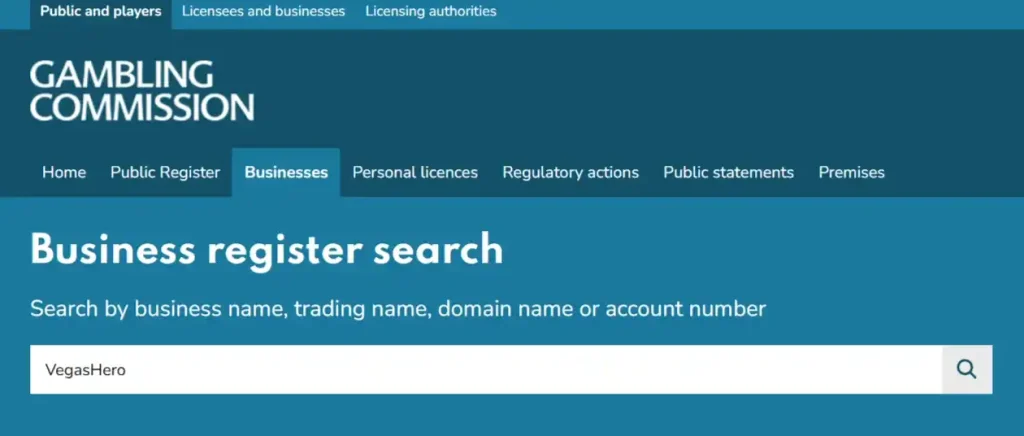
VegasHero UK Guide
Independent casino review and regulatory context
Licence and trust check – 11 September 2026
No current UK Gambling Commission licence was verified for VegasHero as of 11 September 2026. That result matters most for readers in England, Scotland and Wales because the UKGC says remote gambling businesses serving consumers in Great Britain need a Commission licence, including operators based overseas. Northern Ireland is legally distinct: the UKGC does not regulate the provision of remote gambling there, although separate advertising rules can still involve Gambling Act requirements. This page therefore avoids a binary “legit” or “scam” label and focuses on the dated register result, the protections attached to the licensed Great Britain framework, the separation between historical and current VegasHero records, and the limits of third-party reputation scores.
The local-licence check was repeated on 11 September 2026.
Remote operators serving British consumers need a Commission licence.
UKGC remote licensing should not be described as one UK-wide regime.
Older Genesis-era Vegas Hero material should be kept separate from the current operation.
Table of Contents
- The current VegasHero UKGC register result
- Why the Great Britain licence requirement matters
- Northern Ireland is not the same licensing question
- Historical Vegas Hero records are not current authorisation
- What protections exist inside the UKGC-licensed Great Britain framework
- Why visible regulation is a stronger trust signal than branding
- Current third-party reputation signals are mixed and secondary
- A trust-check sequence for UK readers
- GAMSTOP and self-exclusion need their own scope check
- Primary and current sources used for the trust check
- What VegasHero’s UK licence position means for player protection
- Is VegasHero Licensed in the UK? UKGC Check, Regulation and Trust Signals
The current VegasHero UKGC register result
The most important finding is narrow and dated: no current UK Gambling Commission licence was verified for VegasHero on 11 September 2026. This wording is deliberate. It reports what the current public register check established without pretending that a search result can answer every legal question about every jurisdiction in the United Kingdom.
The UKGC public register is the right source for a local Great Britain licence claim because it can be searched by business, trading name and domain information. A third-party casino review can provide useful context, but it is not a substitute for a current regulator record when the question is whether a brand is UKGC-licensed.
For a broad review of the casino before focusing on regulation, return to the VegasHero review. This page stays on the narrower trust and licensing question.
Why the Great Britain licence requirement matters
The UK Gambling Commission states that businesses providing remote gambling to consumers in Great Britain need a Commission licence, even if the business is based outside Great Britain. In practice, Great Britain means England, Scotland and Wales for this licensing discussion.
The legal framework centres on the Gambling Act 2005, as amended by the Gambling (Licensing and Advertising) Act 2014. The important reader-facing point is not the statute name by itself. It is that a UKGC operating licence connects an online operator to a specific set of regulatory requirements, supervision and enforcement powers in the Great Britain market.
That is why a UK licence cannot be inferred from English-language support, GBP-facing marketing, a working registration journey, a familiar payment method or a polished mobile site. Those are service features. A local operating licence is a separate regulatory fact and needs a register basis.
Northern Ireland is not the same licensing question
Calling the issue simply a “UK licence” can hide an important legal boundary. The UKGC states that it does not regulate the provision of remote gambling in Northern Ireland, while its current scope guidance notes that Gambling Act advertising restrictions can still apply there. Northern Ireland has its own gambling-law framework under the Betting, Gaming, Lotteries and Amusements Order 1985 as amended by the 2022 Act.
For that reason, this page does not turn a Great Britain register result into a blanket statement covering every UK nation in the same way. Readers in England, Scotland and Wales can use the UKGC register outcome directly when asking about local remote licensing. Northern Ireland requires separate legal treatment and should not be collapsed into the Great Britain model.
Historical Vegas Hero records are not current authorisation
The current VegasHero operation dates from 2025, and older Genesis-era Vegas Hero material is historical. That distinction matters because archived regulator notices can remain highly visible in search results long after an operator relationship changes.
Historical UKGC enforcement material that mentions the Vegas Hero brand in the Genesis Global context can help explain the brand’s past, but it cannot be reused as evidence of a current VegasHero operating licence. A historic domain association and a current licence entry are different things.
This is a useful rule beyond this one brand: when a casino name has been reused, relaunched or transferred, match the date, legal entity and current domain evidence before treating an old regulator page as present-day authorisation.
The same discipline applies to current terms. Terms can show what the service says about accounts, payments, bonuses or responsible gambling, but a terms page is not itself a Great Britain operating-licence record. Conversely, a historical UKGC notice can prove that a named company or domain was regulated in an earlier period without proving the status of a later operation using similar branding. For a reader trying to make a present-day decision, the date and identity attached to each source matter as much as the brand name printed at the top.
What protections exist inside the UKGC-licensed Great Britain framework
UKGC rules are useful here as a benchmark because they show what local licensing changes for a consumer. They must not be presented as VegasHero features without a verified VegasHero licence. The comparison is about the framework, not about attributing compliance.
For brand-specific detail, compare this market framework with the bonus terms, payments and registration and KYC.
| UKGC framework example | Current rule | How to read it for VegasHero |
|---|---|---|
| Online slots stake caps | £5 per game cycle for customers aged 25+ and £2 for ages 18-24. | A rule for UKGC remote-casino licensees, not evidence that VegasHero applies these caps. |
| Bonus wagering | Since 19 January 2026, incentive wagering requirements for UKGC licensees are capped at ten times, and mixed-product incentives are banned. | A Great Britain licensed-market benchmark; compare it with the separate VegasHero bonus terms rather than assuming the rule applies. |
| Financial vulnerability checks | Remote licensees use light-touch checks at the published £150 net-deposit threshold over a rolling 30 days. | This describes the UKGC remote framework, not a verified VegasHero account-control feature. |
| Credit cards | UKGC-regulated online betting, casino and bingo operators in Great Britain cannot accept credit-card gambling payments, including credit-card-funded e-wallet use. | Do not infer the VegasHero cashier from this rule; use the separate payments guide. |
| Age and identity | Remote licensees must verify age before deposit or gambling and verify at least name, address and date of birth before play. | Use the registration and KYC guide for VegasHero’s own stated process. |
Why visible regulation is a stronger trust signal than branding
UKGC consumer-trust research identifies visible regulatory oversight and accountability as important trust drivers for Great Britain gambling consumers. That helps explain why the register result should carry more weight than visual cues such as a professional design, a large catalogue or promotional language.
A regulator can set licence conditions, assess compliance and take enforcement action against its licensees. A review score, by contrast, is an editorial judgement created by a third party. It can still be useful, but it belongs in a different evidence category.
The same distinction applies to product breadth. VegasHero has a large games, but game count does not answer who regulates the operator. Trust analysis works better when features and regulatory facts are kept separate instead of allowing one to stand in for the other.
Current third-party reputation signals are mixed and secondary
Casino Guru’s July 2026 review gives Vegas Hero a Safety Index of 5.5 out of 10, labelled “Below average”. That rating is a current editorial signal from one review platform, not a regulator decision and not a legal status.
AskGamblers also records a low CasinoRank and current player complaints for Vegas Hero. Complaint pages can add useful information about the kinds of problems players report, but individual complaints vary in outcome and should not be converted into a blanket claim that every customer will have the same experience.
Taken together, these sources make the trust picture more cautious, but they do not replace the UKGC register. The most decision-relevant hierarchy is: first establish local licensing from the regulator, then read the operator’s current terms, then use independent review and complaint sources as supporting context.
A trust-check sequence for UK readers
1. Check the regulator record
Search the UKGC business register for the current brand, trading name and domain before relying on licence claims made elsewhere.
2. Separate current and historical entities
Match the date and operator context. Older Genesis-era material should not be treated as current VegasHero authorisation.
3. Read product terms separately
Promotions, games, payments and KYC each have their own terms. A UKGC benchmark does not automatically rewrite the operator’s published conditions.
4. Treat reputation scores as evidence, not licences
Independent ratings and complaints can inform a decision, but they cannot create or replace regulatory coverage.
GAMSTOP and self-exclusion need their own scope check
GAMSTOP is part of the Great Britain online self-exclusion framework for operators licensed there. Because no current UKGC licence was verified for VegasHero, this page does not imply that GAMSTOP coverage attaches to the brand.
The dedicated GAMSTOP handles that question in detail. Keeping it separate prevents a common mistake: assuming that a casino accessible to a UK reader automatically participates in the protections required of UKGC remote licensees.
Primary and current sources used for the trust check
The local-licence result and Great Britain regulatory examples were rechecked against UK Gambling Commission sources. Historical brand material and current third-party reputation pages are used only in their proper context.
- UK Gambling Commission public business register
- UK Gambling Commission remote sector guidance
- UK Gambling Commission regulatory scope
- UKGC online slots stake-limit guidance
- UKGC promotional wagering changes
- UKGC financial vulnerability checks update
- UKGC credit-card gambling rule
- UKGC age and identity verification rules
- Northern Ireland Department for Communities gambling framework
- Casino Guru Vegas Hero review
- AskGamblers Vegas Hero review
What VegasHero’s UK licence position means for player protection
The decisive Great Britain signal is the register result: no current UKGC licence was verified for VegasHero on 11 September 2026. That means the protections described for UKGC remote licensees – including local licence conditions around slot stakes, promotional wagering, credit-card use, financial vulnerability checks and identity verification – should not be attributed to VegasHero without a licence basis. Northern Ireland remains a separate legal question, and historic Genesis-era records do not change the current result. For a UK reader, the strongest trust method is to verify regulation first, keep service features separate from authorisation, and use independent ratings and complaints only as supporting evidence rather than as substitutes for a regulator record.